
CONTATTI
CONTATTI
eventisansilvestroquirinale.org
New Year's Eve
Concerts in Rome
info@eventisansilvestroquirinale.org
sede: Via Fonte Caia 17 - Contigliano (RI)
+39 6 5654.9787
Upon request, we organize guided tours of the Church of San Silvestro al Quirinale, according to the Mercy route or the Art route. If concerts take place, the visits are included in the package offered to the guest.
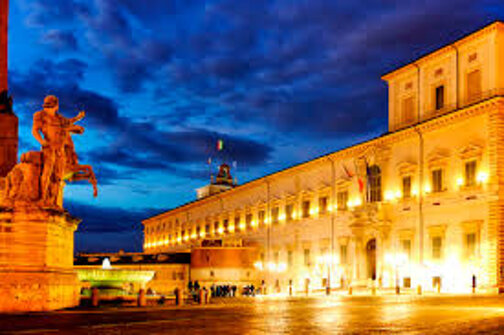
the secret church on highest hill in Rome
Located on the Quirinale Hill, the center of power in modern Rome, is the Church of San Silvestro, rarely open to the public.
It reserves its pictorial and architectural treasures, its atmosphere of meditation and devotion, only for those who have the patience to wait.
From an anonymous door, and then up a three-arched staircase, you arrive at this treasure chest.
Born in 1000, it was the subject of interventions until 1876.
More than a thousand years of history await you!
Middle Ages, Renaissance, Baroque in Michelangelo's favorite church
Here, in fact, the group of eminent people who debated the reform of the Catholic Church in the 15th century met, in which Michelangelo and his mentor Vittoria Colonna, Roman poet and noblewoman, participated.
Born around the year one thousand, therefore in the early Middle Ages, the Church was the subject of various interventions that took place during the Renaissance, the Baroque era and finally in the eighteenth century.
The church houses the following architectural works adorned with statues, paintings, altarpieces: Bandini Chapel, Chapel of San Silvestro, Chapel of the Theatine Saints, Chapel of the Nativity Scene, Chapel of Fra' Mariano, Sacristy, Presbytery and choir, Chapel of the Madonna del Latte, Michelangelo's Cloister.
It is currently entrusted to the Vincentian fathers and is open for worship only on Sunday mornings.
Cappella Bandini
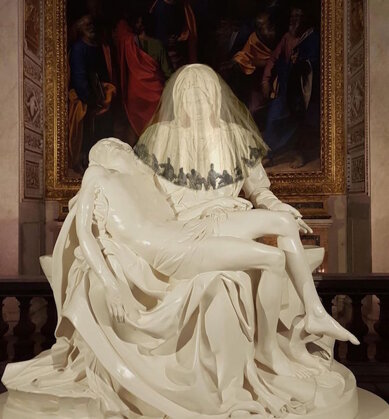
With an octagonal plan, it was built between 1580-1585 based on a design by Ottaviano Mascarino, by Pier Antonio Bandini and his wife Cassandra Cavalcanti and completed in 1629 by his son Ottavio, cardinal. In the background stands the sumptuous altarpiece, depicting the Assumption of Mary into heaven painted on slate by Scipione Pulzone in 1585. On the occasion of the Jubilee of Mercy, a copy of the Vatican Pietà by Michelangelo Buonarroti was placed there for a specific reason.
After Michelangelo met Vittoria Colonna on S. Silvestro, he gave her a paper drawing of the Pietà. Then, feeling death near, he began the sculpture of a Pietà for his tomb. After his death, the unfinished work was purchased by the Bandinis and kept in a vineyard on the Quirinale they owned, then sold to Cosimo III, Grand Duke of Tuscany and taken to Florence. In a certain sense therefore this placement is a homecoming. We find on the left, the monument of Cardinal Ottavio Bandini, with the bust of the sculptor Giuliano Finelli (1602ca-1657), the theme is of the religious vocation, expressed by the two statues by Alessandro Algardi representing Mary of Bethany and St. John the Evangelist.
On the right, under the monument in honor of Pier Antonio Bandini and his wife, there are two statues by an unknown sculptor, of less valuable workmanship, but indicating the matrimonial vocation. On the left there is St. Joseph who welcomed Mary, the Mother of Jesus, as his bride and Martha, the sister of Mary of Bethany and Lazarus, who had the merit of welcoming Jesus and serving him. In the plumes there are four oval frescoes by Domenichino (1581-1641). The subjects are Marian figures: David dances in front of the Ark of the Covenant: Mary is the new ark because she brings the Son of God into the world; Judith with the head of Holofernes: Mary conquers evil; Esther before Ahasuerus: Mary intercedes for the weak; Solomon and Bathsheba: intercession of Mary.

Iscriviti alla Newsletter
Rimani aggiornato su tutte le novità. Lasciaci la tua mail qui accanto
Madonna del Latte
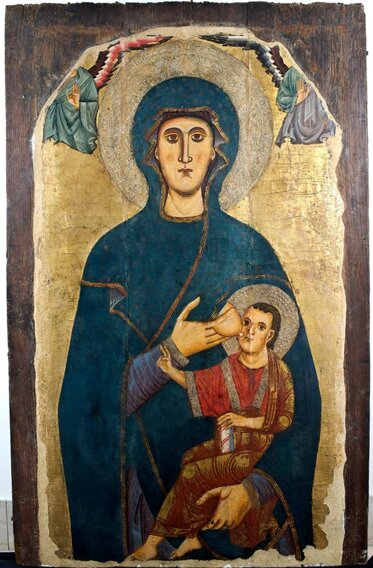
In the center of the rectangular chapel, richly decorated with inlaid marble and golden stucco, there is a niche with the icon of the Madonna, on a golden background, breastfeeding Baby Jesus (Galaktotrophousa), from the Roman school of the 1320s. The Mother of God is dressed in a blue cloak (mophorion) edged with gold, which also covers her head. With one hand she offers her breast to her Son and with the other she supports Jesus who appears to be weightless. Our Lady looks at the faithful as Mother of the Church who follows the destiny of each of her children, and almost challenges them to ask them if they are willing to welcome her Son into faith. Jesus wears a red tunic and a palio highlighted in gold. He raises his right hand with the classic gesture not only of blessing, but of revelation of the Trinitarian (one God in three persons) and Christological (true God and true man) dogmas. The left hand is placed on the scroll of the Gospels to indicate to us that He is the Light of the World.
On the pillar on the left S. Longinus, the converted centurion who pierced the heart of Christ on the cross, full of merciful love for us. On the floor, in front of the sweet image of Mary, there is the tombstone of the card. Scipione Rebiba (1504-1577), known in Rome because the Rebibbia prison was built on his land. He was a man of Paul IV Carafa, a very severe pope, and was involved in inquisitorial trials, including that of Pietro Carnesecchi (1508-1567), which ended with the beheading and burning of the accused. The contrast between Mary's eyes and the icy marble surface of this inquisitor makes us think that a sweet and merciful Church leads to Christ, while a Church that limits itself to condemning only serves to drive away people in search. ("Where it is a question of bestowing grace, Christ is present; when severity must be exercised, only his ministers are present": Ubi gratia largienda est, Christus adest, ubi exercenda severitas adsuntmini: S. Ambrogio, De Abraham I, VI, 50).

New Year's Eve Concerts in Rome